Search "best roofing material" and you'll get a dozen articles that all hedge. Here's a straight ranking instead — based on how long each material actually lasts, what it costs, and crucially, whether it makes sense on a house in the Pacific Northwest.
One thing to get out of the way first: the material that lasts longest on paper is not the one most people should buy. Slate can outlive three generations, but it weighs so much that most homes need structural reinforcement before it can go on. Practical matters.
The Short Answer
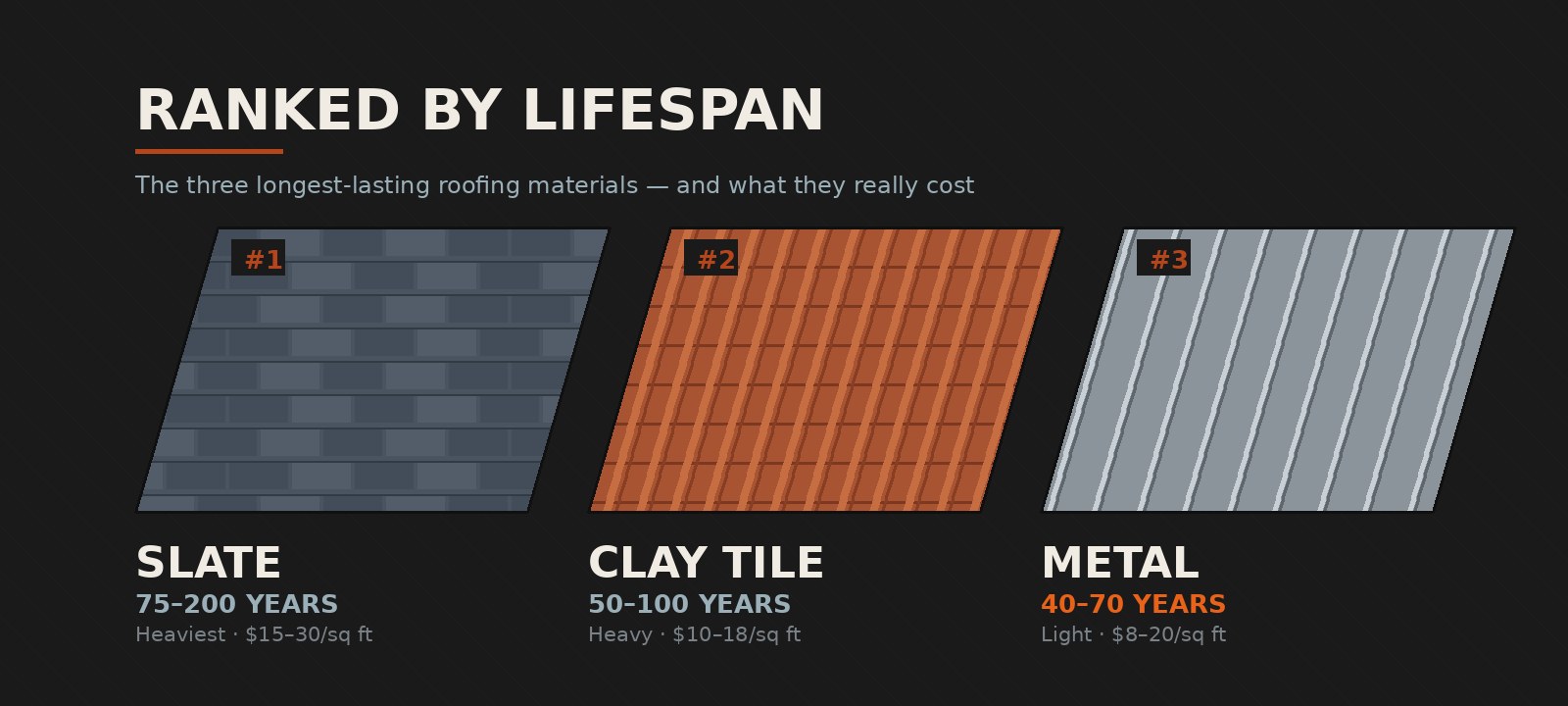
Longest-lasting on paper: slate (75–200 years), then clay tile (50–100), then metal (40–70). Lowest actual cost per year: metal — because it's the only one of the three that doesn't need structural reinforcement, an engineer's report, and a permit before it can go on. It's also the only one moss can't take hold of.
Ranked: Roofing Materials by Lifespan
Slate
Genuine stone, quarried and split. Slate roofs from the 1800s are still keeping water out today, and it's fireproof, rot-proof, and essentially immune to weather.
The catch: it's extraordinarily heavy — often three to four times the weight of metal. Most standard-framed homes need their roof structure reinforced to carry it, and that isn't just carpentry: it means a structural engineer's report, a building permit, and an inspection before the roof can even start. Budget $12,000–$18,000 and several extra weeks before a single tile goes on. Installers who know slate are also rare here, and a poor install wastes the material's whole advantage.
Clay & Concrete Tile
Excellent longevity and unbeatable on Mediterranean or Spanish-style architecture. Naturally fire-resistant with a Class A rating.
The catch: heavy like slate, so the same engineering report, permit, and reinforcement bill usually applies — typically $10,000–$15,000 before the roof itself. Tile is also brittle, and it performs worst where moisture gets into the material and then freezes.
The bigger issue in a damp climate is moss. Clay and concrete are porous with textured, overlapping surfaces — exactly what moss and lichen need to take hold. On a wet coast, tile roofs need regular cleaning and treatment, and moss left alone traps moisture against the tiles and works into the laps. A tile roof can absolutely last 70 years here, but not an unmaintained one.
Metal — Standing Seam, Corrugated, Copper
This is where longevity meets practicality. Metal delivers most of slate's lifespan at a fraction of the weight and cost, and it's the fastest-growing residential roofing material in North America for exactly that reason.
It also happens to be the best-suited material to a wet coastal climate. Water sheets off it instead of soaking in. Moss can't grip a smooth metal panel the way it grips the granular surface of asphalt. Wind ratings don't degrade with age the way a shingle's tar seal does. And metal reflects heat rather than absorbing it, which is where the 20–30% energy savings figure comes from.
The catch: the upfront cost is real — typically 1.5 to 1.8 times asphalt, depending on profile and roof complexity. It's a meaningful premium, though nowhere near the multiple slate or tile command. And installation quality matters enormously: the panel will last 50 years, but only if the flashing, fasteners, and detailing are done properly.
Worth noting what metal doesn't cost you: at roughly a quarter the weight of slate, it drops onto existing framing without engineering reports, structural permits, or reinforcement. A straight re-roof, not a construction project.
Synthetic Composite
Engineered polymer shingles that mimic slate or cedar convincingly, at a fraction of the weight. A reasonable middle path if you want a traditional look without the structural upgrade.
The catch: a newer category, so 50-year claims rest more on lab testing than on 50-year-old roofs you can go look at.
Cedar Shake
Nothing else weathers to that silvery West Coast grey. On the right house it looks like it grew there.
The catch: in a damp climate, cedar is a maintenance commitment — cleaning, treatment, and moss control, indefinitely. Skip it and the top of that range drops fast. Many fire-prone areas also restrict it.
Asphalt Shingles
The default for good reason: cheapest upfront, every roofer installs it, and it can be done in a couple of days. Architectural shingles land at the upper end of that range; basic 3-tab at the lower.
The catch: in constant damp, asphalt underperforms its rating. Moss lifts and separates shingles, and granule loss accelerates. A 25-year shingle in a wet coastal climate often becomes a 15-year one.
Cost Per Year — The Number That Actually Matters
Sticker price is the wrong comparison. What matters is what you pay per year of roof you get — and crucially, that has to include the work needed to make the roof possible in the first place.
Most guides quietly leave that part out. If a material requires a structural engineer's report, a building permit, and framing reinforcement before it can go on, that's not a footnote — it's often ten to eighteen thousand dollars and several weeks of schedule. Here's the same comparison with those costs where they belong, on a typical 2,000 sq ft roof:
| Material | Lifespan | Roof cost | Structural + permit | Total | Cost per year |
|---|---|---|---|---|---|
| Asphalt (architectural) | 20 yrs | $14,000 | — | $14,000 | $700 |
| Cedar shake | 35 yrs | $22,000 | — | $22,000 | $629 |
| Metal (standing seam) | 55 yrs | $28,000 | none required | $28,000 | $509 |
| Clay tile | 70 yrs | $28,000 | +$12,000 | $40,000 | $571 |
| Slate | 100 yrs | $44,000 | +$15,000 | $59,000 | $590 |
Once the engineering is counted, metal has the lowest cost per year of any material on the list — including the two that technically outlive it. Slate and tile only win that column on paper, in the version of the calculation where the structural work is free.
A fair caveat: not every home needs reinforcement. If yours was purpose-built for tile, or was framed heavily enough to take the load, those numbers drop and tile gets very competitive. But that's the exception on standard residential framing, and it's something an engineer has to confirm — which is itself a cost.
The Permit Side Nobody Mentions
Reinforcing a roof structure is structural work, and structural work needs a building permit. That means drawings, an engineer's letter, submission, review time, and inspections — on top of the trade cost. Depending on the municipality it can add weeks to a project that would otherwise be a straightforward re-roof.
A metal roof, by contrast, is generally a like-for-like replacement on existing framing. Same permit path as any standard re-roof, no engineering, no waiting on a structural review. For a lot of homeowners that difference in hassle matters as much as the money.
What Actually Decides It for Your House
- How long you're staying. Selling in two years? Asphalt's low upfront cost wins, full stop. Staying fifteen or more? The math flips hard toward metal.
- Your climate. Wet and moss-prone rewards materials water runs off. Hot and dry favours tile. Wildfire risk rules out untreated cedar.
- Your roof structure. Slate and tile may require reinforcement. Metal and composite generally don't.
- Your house's architecture. A heritage home and a modern build have genuinely different right answers.
- Installer availability. A material is only as good as the crew putting it on — and for slate especially, that crew is hard to find.
So, Best Roofing Material in 2026?
If budget is genuinely unlimited and your structure can already carry it, slate is the best roof money buys. That's the honest answer and it isn't close — nothing else lasts a century and a half.
But that condition — if your structure can already carry it — is doing enormous work in that sentence, and for most homes it isn't met. Once you count the engineering, the permit, and the reinforcement, metal comes out with the lowest true cost per year of any material available, at a fraction of the disruption. That's why it keeps taking market share from asphalt year after year.
On a wet coast the case is stronger still: metal is the one long-life material that moss can't get a grip on, which quietly removes a maintenance cost that follows tile and cedar around forever.
And if you're staying put only a few more years, there's nothing wrong with asphalt. The best roof is the one that matches how long you'll be under it.
Weighing your options? We'll look at your roof, your structure, and your timeline, then tell you straight what fits — including when metal isn't the answer.
Get a Free AssessmentMore reading: Victoria roofing services · How long roofs last here · Metal vs asphalt in depth · What replacement costs